



A lob wedge has between 58° and 64° of loft, and the real choice for most golfers comes down to a 58° or a 60°. Lofts of 62° and 64° exist, but most golfers stop at 60° because it's far easier to hit consistently.
The useful answer to what degree is a lob wedge depends on the club next to it in your bag, your sand wedge, and on the ground you play most weeks. Get those two right and the loft choice is simple.
Below, we cover the loft range, how to gap your lob wedge from your sand wedge, how much bounce it needs, and when a 58° fits better than a 60°. If you've already settled on a 60°, our 60 degree wedge guide covers how far it goes and when it earns its slot. This piece is about choosing the loft in the first place.
What Degree Is a Lob Wedge Across the Wedge Family
Wedges are mostly sorted by loft, and the lob wedge sits at the top of the family. Golflounge's golf glossary lists the typical ranges like this: pitching wedge about 43° to 48°, gap wedge about 48° to 52°, sand wedge about 54° to 58°, and lob wedge about 58° to 64°. It adds that the most common lob wedge lofts are 58°, 60° and 62°.
Other guides draw the line in roughly the same place. GOLFTEC's June 2026 wedge guide gives the lob wedge as 58° to 64°, while Golf Sidekick's wedge distance chart, updated the same month, puts it at 58° to 62°. Either way, 60° sits in the middle, which is why so many people treat it as the default lob wedge.
Notice the overlap at 58°. A 58° can be the sand wedge in one bag and the lob wedge in another, What matters is the loft of the club right next to it.
Gap Your Lob Wedge From Your Sand Wedge
Wedge guides usually space each wedge roughly 4° to 6° apart, so the distance steps between them stay even. Your lob wedge should therefore sit 4° to 6° above your sand wedge. Here's how that plays out with the usual sand wedge lofts:
| Sand wedge | Lob wedge | Gap | Verdict |
|---|---|---|---|
| 54° | 58° | 4° | Even |
| 54° | 60° | 6° | Wide end |
| 56° | 60° | 4° | Even |
| 56° | 58° | 2° | Too tight |
| 58° | 62° | 4° | Even |
The fourth row is the one to watch out for. The glossary puts it bluntly: behind a 56° sand wedge, a 58° lob wedge is only two degrees away and adds little. You'd be carrying two clubs that land in almost the same spot, and in a bag capped at 14 clubs by the Rules of Golf, that's a slot you could use elsewhere.
The last row covers the bag that already plays a 58° as its sand wedge. GOLFTEC's gapping table carries that chain on to a 62° lob wedge. If your sand wedge is 54° or 56°, though, the answer lands on 58° or 60°.
Not sure what your sand wedge is? Check the sole or the spec sheet for its loft. If you're still choosing the sand wedge itself, our sand wedge loft guide walks through the 54° versus 56° decision.
When a 58° Fits and When a 60° Does

Two degrees sounds like nothing, and around the green it nearly is. The difference shows up mostly on fuller swings and in how the club fits the rest of your bag.
A 58° is the friendlier full-swing club. For most average golfers, a 58° is the easier club to hit and to control for distance. It also works out of deep bunkers, provided it carries at least 10° of bounce.
A 60° launches the ball higher and stops it faster, which is exactly what you want when you're short-sided over a bunker with little green to work with. The trade is that full swings get harder to control, because a small contact error changes the distance a lot with that much loft.
Here's how to choose:
- Pick the 58° if your sand wedge is 54°, you like to hit full or three-quarter shots with your top wedge, or you want one club that doubles as a bunker option.
- Pick the 60° if your sand wedge is 56°, you face a lot of short-sided pitches and high-lipped bunkers, and you mostly use the lob wedge for partial shots around the green.
If your answer is "both sound like me," let the gap decide. Whichever loft keeps a 4° step from your sand wedge is the one that keeps your yardages tidy. Your ego may want the 60° either way. Your scorecard cares more about the gap.
How Much Bounce a Lob Wedge Needs
Bounce is the angle on the sole that stops the leading edge from digging into the ground. On a lob wedge, it matters as much as the loft, because you use this club from sand, rough and tight lies, often with the face wide open.
GOLFTEC's guide sorts bounce into three bands:
- Low, 4° to 8°: firm fairways, tight lies and a shallow swing.
- Mid, 8° to 12°: most amateur golfers on most courses.
- High, 12° and up: soft turf, a steep swing and bunkers.
Low bounce on lob wedges is a tour habit. The traditional advice pairs a higher-bounce sand wedge with a lower-bounce lob wedge, which suits a golfer who sweeps the ball off hard, dry turf. On soft ground or in fluffy sand, though, low bounce digs in more easily, and more bounce is the more forgiving sole for most golfers. That's where a high-bounce lob wedge earns its keep, especially when you open the face.
The shape of the sole matters too. A sole with material ground away at the heel and toe makes it easier to open the face. So read bounce and grind together, then match them to your turf and your swing, not to what a tour player carries.
Our Skyforger 002 Lob Wedges, 58° and 60°

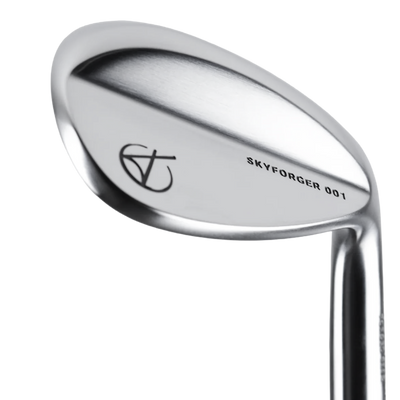
We make the Skyforger 002 in both lob wedge lofts, 58° and 60°. Both come in our V grind with 12° of bounce, which puts them in the high band above.
We built the V grind as a higher-bounce sole with a tapered cut on the rear, so the face sits flatter when you open it. That makes our lob wedges a natural fit for soft turf, fluffy sand and steeper swings, and for the golfer who likes to open the face around the green.
Right-handed, the 52°, 54° and 56° below them each come in two soles, the 10° F grind and the 12° V grind, so you can pick your sand wedge's loft for the gap and its bounce for your bunkers. Left-handed, we make the 60° V as the lob wedge, alongside the 48°, 52° and 56°.
Before you buy, read the specs against the wedges you already carry. Both lob wedges have a 316 g head, a 64° lie and 0.1 mm of offset, and measure 34.75 inches with the grip. Both heads are cast in 8620 steel and carry full-face grooves. Each one ships with a KBS Tour stiff shaft and a Lamkin Crossline Black grip.
Pick Your Lob Wedge Degree in Three Steps
- Read the loft of your sand wedge. Check the sole or the spec sheet.
- Add 4° to 6°. For a 54° or 56° sand wedge, that usually means a 58° or 60° lob wedge.
- Choose bounce for your ground. Soft turf, fluffy sand, a steeper swing or an open face all suit our 12° V. If your course plays firm, keep the lower bounce in the sand wedge below it, where our 52°, 54° and 56° come in the 10° F grind.
Your wedges only make sense when the irons above them are right, though. Our fitting tool matches an iron set to your swing, and that set's last wedge is where your wedge gapping starts.
FAQs About Lob Wedge Degree
Is a 60 Degree Wedge a Lob Wedge?
Yes. A 60° sits in the middle of the 58° to 64° lob wedge range and is the loft most people picture when they hear "lob wedge." Whether it's the right one for you depends on the gap to your sand wedge.
Is a 58 Degree Wedge a Sand Wedge or a Lob Wedge?
It can be either. Sand wedges run from about 54° to 58° and lob wedges from about 58° to 64°, so a 58° plays whichever role your bag needs. Behind a 54° it's your lob wedge, and as the top wedge in a 50°, 54°, 58° setup it's the lob wedge and a second bunker club.
What Bounce Should a Lob Wedge Have?
It depends on your turf and swing. Lower bounce, around 4° to 8°, suits firm lies and shallow swings. Bounce of 12° and up suits soft turf, fluffy sand and steeper swings, especially when you open the face.
How Far Does a Lob Wedge Go?
Not far, and that's the point. A wedge distance chart updated in June 2026 puts the average male golfer's full-swing lob wedge at 50 to 80 yards. Most golfers use it for partial shots around the green, so the step down from your sand wedge tells you more than any full-swing number.


