



If you're stuck choosing between a 54° and a 56° sand wedge, the answer isn't in the bunker. It's in the club above it.
The 56° is the more common of the two among golfers above a 10 handicap, but which one belongs in your bag depends on your gap wedge. Our rule is simple: add about four degrees to the wedge above it and you have your answer.
Below, we cover how your iron set decides the loft, who actually carries each one, and why we think the sole and bounce do more of the work in the sand than the two degrees everyone argues about. That last part is the honest twist, and it's where most of the buying decision really sits.
Your Sand Wedge Loft Starts With Your Gap Wedge

A sand wedge isn't a fixed number. MyGolfSpy's guide to how many wedges you need puts it "typically in the 54- to 56-degree range," and the reason for the range is the club above it. As a rule of thumb, you want even loft gaps of about four degrees, which gives you even distance gaps.
That makes the sand wedge the second step down from your pitching wedge. First comes your pitching wedge, then a gap wedge usually somewhere between 50 and 52 degrees, and then the sand wedge four degrees below that. A 50° gap wedge points to a 54, while a 52° points to a 56.
The catch is that pitching wedges no longer agree. MyGolfSpy notes that a pitching wedge "in one set might be 41 degrees while another is 46 degrees." Our own current iron sets show it too, and they lead to different sand wedges.
| Iron set | Set ends at | Next wedge | Sand wedge |
|---|---|---|---|
| 101 MKII | 48° GW | 52° (your gap wedge) | 56° |
| 201 MKII | 46° PW | 50° | 54° |
| 301 CB | 47° PW | 52° or 50° | 56° or 54° |
The Iron 101 MKII (5-GW) already ends at a 48° wedge we label GW, so four-degree steps from there give you a 52, which does the gap wedge's job, and a 56 as the sand wedge. The Iron 201 MKII (4-PW) stops at a 46° pitching wedge instead, which makes 50 and 54 the even steps. The Iron 301 CB (4-PW) has a 47° pitching wedge, so 52 and then 56 works with one five-degree step.
That's the same brand with two different sand wedge lofts, which is why we ask you to check the loft printed on your own set's spec page before you buy anything.
Who Carries a 56 and Who Should Play a 54
In October 2025 MyGolfSpy published Shot Scope's wedge data, broken down by handicap, and it's the part the shopping pages leave out. It shows which lofts golfers carry and which wedge they reach for inside 50 yards.
The 56 is the most carried of the two sand wedge lofts for everyone above a 10 handicap, with 40% of golfers carrying one at 25, 20 and 15 handicap. From 10 handicap down the 54 takes over, and at scratch 50% carry a 54 against 37% for a 56.
| Handicap | Carry 54° | Carry 56° | 56° share ≤50 yds |
|---|---|---|---|
| 25 | 24% | 40% | 25% |
| 15 | 34% | 40% | 23% |
| 10 | 42% | 39% | 23% |
| 5 | 45% | 39% | 21% |
| Scratch | 50% | 37% | 15% |
The last column is the clearest measure of how much a sand wedge matters, because it's the share of all shots from 50 yards and in that golfers hit with a 56. A 25-handicap hits a full quarter of their short shots with it. Of every wedge loft in the data, only the 60 takes more, at 26%.
Better players, meanwhile, spread the load. MyGolfSpy's reading of the data is that "better players gravitate to a 50/54/58 setup, spreading gapping more evenly." In that setup the 54 is the sand wedge, and the 58 takes the biggest share of short shots, 31% for scratch players.
Here's what that means for you:
- Carry three wedges or fewer: a 56 is our honest default. It covers bunkers, pitches and the odd full shot, and Shot Scope's data shows higher handicaps lean on it most for short shots.
- Carry four wedges with a 50° gap wedge: a 54 keeps four-degree steps and leaves room for a 58.
- Already own a 60: a 56 keeps the jump to the lob wedge at four degrees.
Bounce Matters in the Bunker as Much as Loft

In a bunker, digging is the whole problem, and bounce, the sole's angle relative to the leading edge, is the spec that stops it. That's why our answer to 54 or 56 is to sort the gapping first and only then worry about the sole.
Wedge fitting guides usually group bounce in three bands, with low at 4° to 6°, mid at 7° to 10° and high at anything over 10°. They match high bounce to soft turf, fluffy lies and soft sand, and to steep swings that take deep divots. Low bounce, on the other hand, suits firm turf, hard or coarse sand, and a shallow swing that barely bruises the grass.
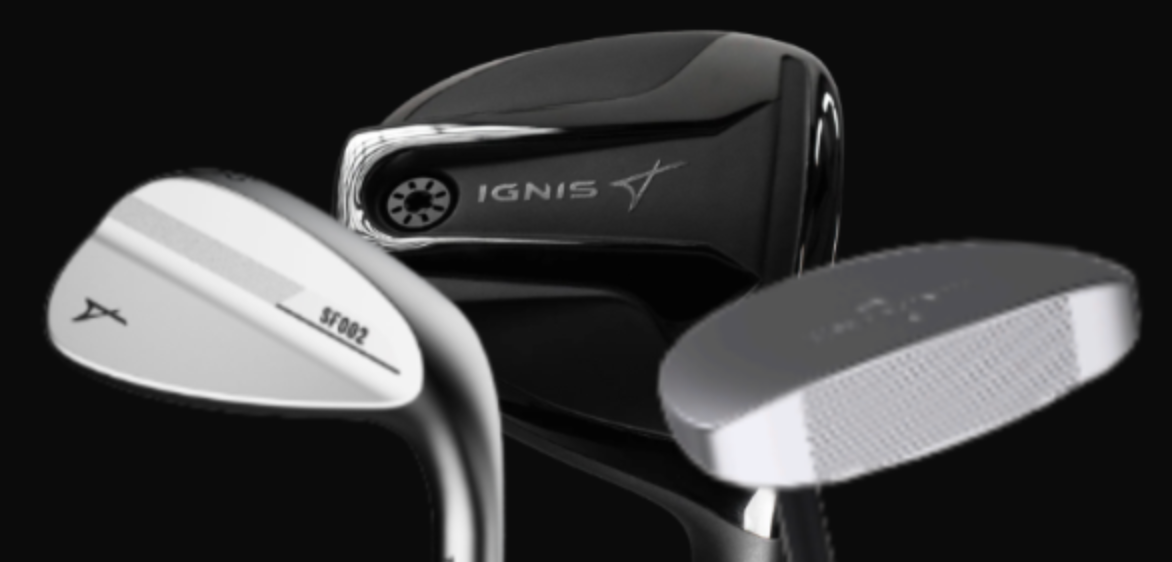
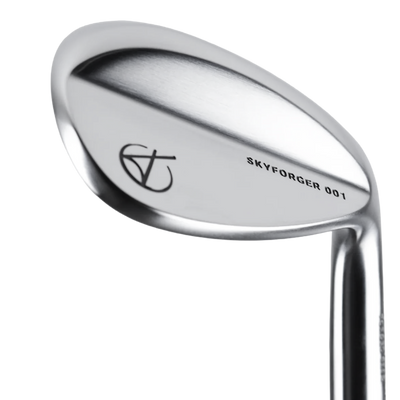
We built that choice right into the Skyforger 002. Both sand wedge lofts, 54° and 56°, are available in two distinct soles, so you pick the loft for your gapping and the grind for your sand.
| 54° and 56° | F grind | V grind |
|---|---|---|
| Bounce | 10° | 12° |
| Sole | Thicker | Rear cut |
| Face use | Square | Opened |
| Left hand | No | 56V only |
Our F grind pairs a thicker sole with the lower bounce, built for maximum forgiveness on shots played square to the path. The V grind gets the higher bounce plus a rear-of-sole taper, so the face sits flatter once you open it.
Here's how to choose between them:
- Pick the V if you open the face in bunkers and around the green, if your course has soft or fluffy sand, or if you take deep divots. Its 12° sits in the high band.
- Pick the F if your sand wedge also hits full shots with a square face, or your turf runs firm to normal. Its 10° sits at the top of the mid band.
Every loft and grind is $99 USD, cast from 8620 steel with a 64° lie, 0.1 mm offset, and a 312 g head on the 54 and 313 g on the 56. It ships with a KBS Tour stiff shaft and a Lamkin Crossline Black grip in standard or midsize.
Check the Gap Before You Buy

Loft gets you close, but yardage tells you if it worked. Hit ten full shots with your gap wedge and ten with your current sand wedge, then compare the average carry.
MyGolfSpy's test for whether two wedges are enough is that they don't leave "a 30-plus-yard hole in your bag," and the same yardstick works between your gap wedge and sand wedge. A hole that size means the loft between them is too wide. If the two land on top of each other, you simply own one club twice.
Don't use Shot Scope's distance column to set your yardages, though. Its "performance average" includes chips and pitches, so a 56 averages 52 yards for 25-handicaps and 72 for scratch. That's useful for comparing lofts and useless for picking a club on the tee of a par 3.
For newer golfers, our guide to the best golf clubs for beginners keeps it simpler, with your set's pitching wedge plus a 56° sand wedge with 10° to 14° of bounce. This piece is for the next step, when a gap wedge is already in the bag and the sand wedge has to fit around it.
Golfers blame the sand, the lie and the rake long before they blame their wedge gapping. Yet the right sand wedge loft is usually just four more than the club above it.
Choose Your Sand Wedge Loft Honestly
Our pick for most mid and high handicaps is a 56°, especially if you carry three wedges or a 52° gap wedge. A 54° is right when your gap wedge is a 50 and a 58 sits behind it. After that, let your bunkers and your swing pick the bounce.
Everything starts with your irons, because they set the loft each wedge builds down from. Our fitting tool needs about three minutes and no email, and what comes back is an iron-set recommendation covering head, shaft length and stiffness, lie angle and grip size. Answer it honestly, read that set's pitching wedge loft on the spec page and step down in fours. From there, the Skyforger 002 in 54° or 56° is $99 USD, in whichever grind your sand asks for.
FAQs About Sand Wedge Loft
Is a 56 Degree Wedge a Sand Wedge?
Yes. A 56° is the sand wedge loft carried most often by golfers above a 10 handicap, by 40% of them in Shot Scope's data, and it fits best behind a 52° gap wedge.
Is a 54 Degree Wedge a Sand Wedge?
It can be. A sand wedge is typically 54° to 56°, and a 54 is the natural sand wedge behind a 50° gap wedge. Half of the scratch golfers in Shot Scope's data carry one, and it's the middle club of the 50, 54 and 58 setup MyGolfSpy says better players gravitate to.
What Bounce Should a Sand Wedge Have?
Mid to high bounce suits most golfers, and our beginners guide suggests 10° to 14°. Go higher if your bunkers have soft, fluffy sand or you take deep divots, and go lower if your sand is firm and coarse or your swing is shallow.
How Far Should You Hit a Sand Wedge?
Measure it. Hit ten full swings on a range with yardages, average the middle six, and that's your number. As a comparison only, Shot Scope's performance averages for a 56 include short shots and run from 52 yards for 25-handicaps to 72 yards for scratch players.


