




Walking into a golf shop as a beginner feels like walking into a foreign country. There's loft, lie, offset, bounce, kick point, MOI, CG, and a wall of clubs that all look kind of the same. Every brand promises "uncompromising quality" or "game-changing technology," and the more you read, the less clear things get.
This guide is about the best golf clubs for beginners and the specific characteristics that actually matter when you're picking one up off the rack. Not just "buy a driver," but exactly what loft, head size, and shaft flex to look for, and why. We're Takomo, and we've spent a lot of time helping new golfers cut through the noise and choose gear that actually fits their game.
The Best Golf Clubs for Beginners at a Glance
The best golf clubs for beginners share a few key traits: high loft, forgiving clubheads, perimeter weighting, wide soles, and lighter, more flexible shafts. Drivers should be 10.5° to 12° with a forgiving head. Irons should be game-improvement style with a cavity back. Hybrids replace long irons. Wedges should be at 46° and 56°. Putters should be mallet-style with alignment aids.
What "Forgiving" Actually Means in a Spec Sheet
Every brand calls their beginner clubs "forgiving." But forgiveness isn't a marketing word, it's a set of specific design traits you can spot without needing the marketing copy to tell you.
The first is perimeter weighting, where the clubhead's mass is pushed toward the edges. This makes the club resist twisting on off-center hits, so when you miss the sweet spot, the ball still goes mostly where you wanted. In irons, this is called a cavity back.
The second is a larger sweet spot. In irons, this shows up as a thicker topline and a wider sole. In drivers, it means a 460cc head, the maximum legally allowed.
The third is a low center of gravity, which helps the ball launch higher with less effort. The fourth is higher loft on every club. These four traits are the foundation of game improvement irons and beginner-friendly clubs across the board.
Driver Specs: What to Look For
The driver is the longest, lowest-lofted, and hardest-to-control club in your bag. Beginner-friendly drivers have specific characteristics that make them easier to hit.
Loft: 10.5° to 12°
Forget anything below 10.5°. Lower-lofted drivers are designed for golfers with high swing speeds who can compress the ball, and as a beginner, that's not you yet. Pick the loft that helps you keep the ball in play, not the one the pros use.
Head Size: 460cc
Always pick a 460cc head, the largest size legally allowed. The bigger the head, the bigger the sweet spot, and the more forgiving the club is on mishits. Some drivers come in smaller "compact" sizes for advanced players. Ignore those.
Shaft Flex: Regular or Senior
Most beginners benefit from a regular flex shaft. If your swing is on the slower side, a senior flex will help you load the shaft properly and launch the ball higher. Avoid stiff or extra-stiff shafts no matter what the salesperson tells you. If you're not sure what flex matches your swing, a quick fitting tool can point you in the right direction without committing to an in-person session.
Iron Specs: Where Quality Matters Most

You'll hit irons more than any other club in the bag. Get these right and your scores drop fast.
Set Composition: 5-Iron Through Gap Wedge
Skip the 3 and 4-iron entirely. They're hard for tour pros to hit, never mind beginners. A seven-club set running from a 5-iron through gap wedge is the right starting point, and you'll cover the gap with hybrid clubs. Most modern beginner iron sets are built this way out of the box.
Head Design: Cavity Back, Thick Topline
Look for these visual cues. The sole should be broad, because wide soles glide through grass instead of digging in. Flip the club over and you should see a hollowed-out cavity behind the face. You also want some offset, where the leading edge sits slightly behind the shaft, which helps reduce slices. That said, looks can be deceiving. A game-improvement iron doesn't have to look chunky or old-fashioned to be forgiving. A good example is the Takomo Iron 101 MKII, which is built specifically around forgiveness for newer golfers while still looking sharp at address. MyGolfSpy named it the Best Game-Improvement Iron of 2026.
Shaft Material: Steel vs. Graphite
Steel shafts are heavier, more durable, and provide better feedback. Graphite shafts are lighter and easier to swing fast, which can help beginners with slower swing speeds. Either works fine.
Hybrid Clubs: Your Long Iron Replacements
Hybrids are the single biggest improvement to beginner equipment in the last twenty-five years. They replace the impossible-to-hit long irons with something a beginner can actually use.
Look for a 4-hybrid (around 22°) and a 5-hybrid (around 26°). Together these cover the gap between your fairway wood and your 5-iron. The head should be rounded and compact, like a small fairway wood. That shape glides through grass, has a low center of gravity, and is much easier to hit out of rough than any long iron.
Fairway Wood Specs
You only need one fairway wood. The standard advice has been "everyone needs a 3-wood," but that's wrong for beginners. A 3-wood has only 15° of loft and is difficult to launch off the deck.
A 5-wood (around 18°) or 7-wood (around 21°) is far easier to hit and gives up almost no real distance. Look for a head that gives you confidence at address. The Takomo IGNIS D2 is one head design built in three lofts, so whichever number you land on, you're getting the same forgiveness, the same carbon crown, and the same neutral face, just a different yardage gap.
Wedge Specs
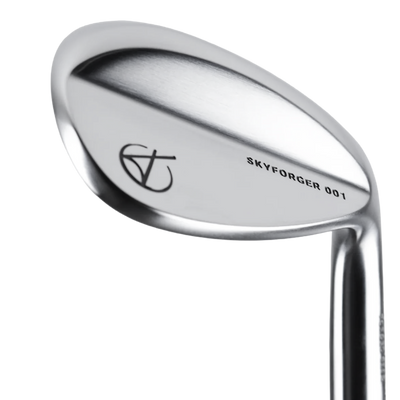
Your pitching wedge comes with your iron set, so you only need to add one more wedge. Add a 56° sand wedge. It handles bunkers, chips, and short approach shots, and it's the only additional wedge a beginner needs.
For your sand wedge, pay attention to bounce, the angle of the sole. Higher bounce means the sole won't dig into soft turf or sand. Look for 10° to 14° of bounce.
Putter Specs
You'll putt nearly half your strokes, so the putter matters more than most beginners realize. Choose a mallet head, not a blade. A mallet has a larger, blockier head that's more forgiving, easier to align, and more stable on off-center strikes.
Standard putter length is 34 or 35 inches depending on your height. Look for clear, bold alignment lines on top. They make it easier to aim, and aiming is half the battle on the green.
Building Your First Set the Right Way

The best beginner clubs aren't defined by brand name or how much you spend. They're defined by specs that match where you actually are in your golf journey. High loft to help you launch easily. Large heads with deep cavities to forgive mishits. Wide soles that glide through grass. Regular or senior flex shafts that let you load the club without overpowering it. Mallet putters with alignment aids to take the guesswork out of every putt.
Put all of that together and the gear stops working against you. You can stop fighting your clubs and start learning the swing, which is the actual point of all of this. As your game develops, you'll notice what each club is doing well and where the gaps are. That's the right time to refine your bag.
FAQs About the Best Clubs for Beginners
What flex shaft should a beginner use?
Most beginners need a regular flex shaft. For driver swing speeds below 85 mph, a senior flex is worth considering, but the right flex depends on which club you're measuring. The same swing speed can call for a different flex in a driver versus a 7-iron. When in doubt, a proper fitting takes the guesswork out of it entirely.
Should I get steel or graphite shafts in my irons?
Steel is the standard and provides excellent feedback at a lower price. Graphite is lighter and easier on the joints, which makes it a good option for older beginners or anyone with slower swing speeds.
What's the difference between a cavity back and a blade iron?
A cavity back has a hollowed-out section behind the face that pushes weight to the perimeter, creating a bigger sweet spot and more forgiveness. A blade has a solid, compact head designed for precision and feel. Beginners should generally choose a game-improvement iron over a blade.
Do I need a 3-wood as a beginner?
No. A 3-wood has too little loft (around 15°) and is difficult for beginners to launch off the deck. A 5-wood or 7-wood gives you nearly the same distance with much higher launch.
How many wedges does a beginner need?
Two. The pitching wedge that comes with your iron set, plus a 56° sand wedge. Other wedges become useful once your short game develops, but they're not necessary at the start.


