




If you're shopping for a 60-degree wedge, the first question isn't which one to buy. It's whether your bag has room for one at all.
For most golfers, it doesn't. In a 2022 guide, Out of Bounds Golf calls the lob wedge the last wedge an average golfer should add to the bag, and adding one to a bag that already has a distance gap elsewhere costs a club slot without solving the real problem. Here's our honest take: it depends on where your current wedge gapping ends and how much bounce the 60-degree head carries. If your sand wedge is 56 degrees and you face shots that demand more height than it can produce, a 60-degree wedge fills the gap. If your sand wedge is 54 degrees, a 58 often makes more sense.
This guide covers when a 60 earns its spot, how far it really goes, which bounce to pick, how to hit it and how it stacks up against a 58, so you can do the math before the purchase.
When a 60 Degree Wedge Earns Its Spot
The 14-club limit means every slot must fill a distance gap or handle a shot no other club can, so a 60-degree wedge earns its place only when it fills a loft gap your current setup leaves open.
The standard gapping rule is 4 to 6 degrees between consecutive wedges, which produces roughly 10 to 15 yards of carry separation per club. That's why your pitching wedge loft comes first. Game-improvement iron sets like our Iron 101 MKII have a pitching wedge at 43 degrees and include a gap wedge at 48. Players-distance sets like our Iron 201 MKII, meanwhile, end at a 46-degree pitching wedge with no gap wedge in the set.
| Your PW Loft | Set Type | Wedge Setup |
|---|---|---|
| 43° (GW 48°) | GI (101 MKII) | 52°, 56°, 60° |
| 46° | Players (201 MKII) | 50°, 56°, 60° |
| 48° | Standard | 52°, 56°, 60° |
The 60 in each row is the lob-wedge slot. Whether you fill it, or build the bottom around a 54 and a 58 instead, is the question we settle in the 58-or-60 section below.
If your sand wedge is 56 degrees, a 60-degree wedge gives you a four-degree step and roughly 10 to 15 yards of separation at the bottom of your bag, and that's where we think it belongs. If your sand wedge is 54 degrees, a 58 fills the gap with less risk.
How Far Does a 60 Degree Wedge Go

The honest number is lower than you probably expect.
In a 2020 Golf Cart Report guide, PGA Professional Brittany Olizarowicz puts a mid-handicap golfer at about 50 to 60 yards with a 60-degree wedge, a higher-handicap golfer at 30 to 40, and a professional at about 100.
In a 2021 informal poll, Out of Bounds Golf asked 10 golfers how far they normally hit their 60-degree wedge and got an average of 74 yards, with a range from 60 to 100 yards, mostly from half and three-quarter swings.
Yet a 60-degree wedge is mostly a partial-swing club, built for short shots of typically 10 to 50 yards with high launch and a soft landing. The part we care about isn't how far it goes. It's whether you face enough of those shots to justify the club slot.
Bounce Is the Spec Most Golfers Skip

Loft gets the attention, but we think bounce decides whether the club works.
Bounce is the angle from the leading edge down to the lowest point of the sole. More of it keeps the sole from digging into the ground, while less lets the leading edge get under the ball on tight lies. At 60 degrees, the right bounce for your swing and your turf decides whether the sole slides or digs.
Wedge fitting experts group bounce into three categories:
- Low bounce (4 to 6 degrees): For firm turf, tight lies, and sweeping swings that take little divot.
- Mid bounce (7 to 10 degrees): A common middle ground, for firm to normal turf and neutral swings.
- High bounce (more than 10 degrees): For soft turf, thick rough, bunker play, and steep swings that dig.
Low bounce on lob wedges came from tour players who found higher-bounce sand wedges made it hard to spin the ball off tight lies. For most golfers, though, higher bounce is more forgiving because the sole skids through the turf instead of digging into it.
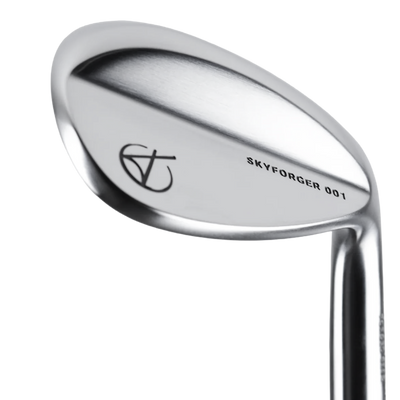
Our Skyforger 002 wedges pair the 60-degree head with 12 degrees of bounce on a V grind, which has a tapered cut on the rear of the sole that lets the face sit flatter when opened. We designed the Skyforger 002 with George and Wesley Bryan, the Bryan Bros, and cast it from 8620 steel with full-face grooves. Each wedge is $99 USD. We gave it the higher bounce so it stays forgiving out of sand and soft lies, while the tapered sole still allows open-face play around the green.
How to Hit a 60 Degree Wedge
The club does the work, and your job is to let it.
Play the ball at center or slightly back, with a stance narrower than a full iron swing and your feet open to the target. Keep your weight favoring your front foot through the entire swing, and make the backswing shorter than you think it should be.
The most common mistake with a 60-degree wedge is decelerating through impact. Olizarowicz puts it directly: swing with speed through the ball, because slowing down before contact is what causes the bad shot. Commit to the shot, accelerate through the ball and don't be afraid to take a little turf.
For a standard pitch, keep the face square and let the loft do the lifting. For a flop shot, open the face before you grip, aim your body left of the target (for a right-handed golfer), and swing along your body line, so the ball launches high and lands soft. Practice the flop on the range before you try it over a bunker.
58 or 60 Degree Wedge

Both work, and the right choice depends on your gapping and how often you need extreme loft.
| 58° | 60° | |
|---|---|---|
| Typical shot (Out of Bounds Golf informal poll) | ~80 yds | ~74 yds |
| Launch | High | Higher |
| Full swings | Felt more consistent | Felt less consistent |
| Best for | All-around | Height, spin |
Out of Bounds Golf's author found the 58 more consistent on full shots, even though he didn't hit it any farther. The 58 handles most of the same shots as a 60.
The 60, meanwhile, launches higher, lands softer and generates more spin on partial shots. It earns its spot when you face tight pins over bunkers, firm greens that need a steep descent angle, or short-sided positions where you need height without distance.
For a mid-to-high handicap golfer who rarely needs a flop or a lob over a bunker, our honest pick is a 58 with a 54 sand wedge above it, or no lob wedge at all and a 56 as your last club. If you play fast greens with tucked pins and you practice your short game, the 60 gives you a shot the 58 can't.
Build Your Wedge Setup From the Gap Down
It comes down to three steps. Check your pitching wedge loft on the spec sheet for your iron set, count down in 4-to-6-degree steps, and pick the bounce that matches your turf and your divot pattern.
A beginner building a first set needs a sand wedge next to the irons. Add a gap wedge if your set stops at the pitching wedge, then a lob wedge. Four wedges is for golfers who practice their short game and know what each club does.
We make the Skyforger 002 wedges from 46 through 60 degrees in two-degree steps, at $99 USD each. The 46, 48 and 50 come in the F grind only, a thicker sole for forgiveness when the face stays square. The 52, 54 and 56 come in the F grind with 10 degrees of bounce or the V grind with 12, and the 58 and 60 come in the V grind with 12 degrees of bounce. A three-wedge set at 52, 56, and 60 degrees costs $297 USD.
Still wondering whether a 60 earns a slot in your bag? One spec decides it, and that's your pitching wedge loft, because every wedge below it steps down from that number. Our fitting tool finds your iron set, and that set's spec table gives you the loft to count down from.
FAQs About 60 Degree Wedges
What Is a 60 Degree Wedge Used For?
A 60-degree wedge is used for high, short shots that need to land softly, like bunker shots, flop shots over hazards and tight approaches to pins with little green to work with. It's built for shots of about 10 to 50 yards.
How Far Should a 60 Degree Wedge Go?
A 2020 Golf Cart Report guide puts a mid-handicap golfer at about 50 to 60 yards with a 60-degree wedge. The club is built for partial shots and touch, not for maximum distance.
What Is the Best Bounce for a 60 Degree Wedge?
If you plan to play your 60 out of bunkers, a 2021 Out of Bounds Golf guide says to look for at least 10 degrees of bounce. Higher bounce prevents digging on soft turf and in bunkers. Low bounce (4 to 6 degrees) suits firm conditions and shallow swings, but it's less forgiving.
Should You Get a 58 or 60 Degree Wedge?
Both are viable. A 58-degree wedge felt more consistent on full shots in Out of Bounds Golf's 2021 test, while a 60-degree wedge launches higher and lands softer. Check your gapping from your sand wedge. If it's 54 degrees, a 58 keeps the four-degree step. If it's 56, a 60 fills the gap cleanly.


