




If you're a high handicapper looking for the best wedge setup, the magic number isn't three or four. It's two.
You need one wedge to fill the yardage gap below your iron set's last wedge, and a 56° sand wedge with 10° or more of bounce to handle the heavy lifting around the greens. The 56° is the loft most high handicappers already rely on when they miss a green, and the data on what golfers actually carry proves this better than any gear list ever could.
This guide walks you through exactly how many wedges to carry, which lofts make sense, and which bounce to choose, so you buy two clubs that actually work together, rather than four that just argue in your bag.
The Data Says High Handicappers Carry the Wrong Wedge

MyGolfSpy published Shot Scope's wedge data by handicap, showing which lofts golfers carry, how often they use each one inside 50 yards and how far each goes on average. The wedge gapping chart by handicap answers this question better than any product list. None of the high-handicap wedge guides we read use it.
Here is what the 25-handicap group looks like in the real world:
| Loft | Carry one | Avg yds |
|---|---|---|
| 52° | 28% | 67 |
| 54° | 24% | 59 |
| 56° | 40% | 52 |
| 58° | 23% | 45 |
| 60° | 46% | 43 |
Distances are Shot Scope's performance average for each loft, including chips and pitches, not full-swing carry.
The 60° is the most carried wedge in the group at 46%, averaging 43 yards. The 58° averages 45 yards. That's a two-yard difference. Meanwhile, the 56° averages 52 yards, only 9 yards more than the 60°. Yet it handles a massive 25% of all shots from 50 yards and in.
The takeaway? For high handicappers, a 60° adds almost zero practical distance over a 58°. Instead, it just adds unnecessary indecision on every short shot between two clubs doing the exact same job. The 56° is already doing the heavy lifting. Give it one reliable partner with a distinct yardage, not a near-identical twin.
The Best Golf Wedges for High Handicappers Come in Pairs
MyGolfSpy's piece on whether you need 3 or 4 wedges says it straight: "A lot of mid- and high-handicap golfers would score better with a properly fitted two-wedge setup than with four wedges they can't consistently strike." Golf Monthly reaches the same place for a 30 handicapper, who "should be just fine with two, maybe three at a push."
The test for adding a third is simple. MyGolfSpy puts it as two clubs that cover your yardages "without leaving a 30-plus-yard hole in your bag." If your two wedges leave no hole that size, a third one is shopping, not strategy.
Fewer wedges also means each one gets more of your practice. We think that matters more than any spec on this page.
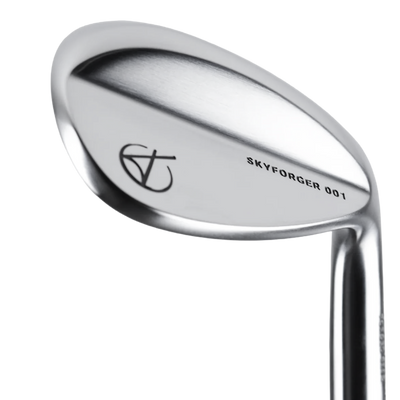
This is where our Skyforger 002 fits. We make it in eight even lofts (46°, 48°, 50°, 52°, 54°, 56°, 58° and 60°). Each wedge is $99 USD, so a two-wedge setup is $198 USD. We make left-handed models in a smaller selection of lofts. You pick the exact two lofts your bag needs, not a boxed set built for someone else's irons.
Start From the Last Club in Your Iron Set

Take the Iron 101 MKII, our game-improvement iron, designed for 15 to 40+ handicaps. Its pitching wedge is 43°, and the set ends with a 48° gap wedge. A good rule of thumb is keeping four to six degrees of loft separation between your wedges. Starting from that 48°, a 52° and a 56° give you perfect gapping.
| Set ends at | Wedge 1 | Wedge 2 | Gaps |
|---|---|---|---|
| 48° GW | 52° | 56° | 4° and 4° |
| 46° PW | 50° | 56° | 4° and 6° |
| 44° PW | 50° | 56° | 6° and 6° |
The Shot Scope numbers show why this works. For 25-handicappers the 52° averages 67 yards and the 56° averages 52. That is a 15-yard step, the kind of gap you can actually feel on the course.
If your set stops at a 43° pitching wedge with no gap wedge, two wedges cannot cover it in even steps. That is the one case where a third wedge, a 48°, earns its place. If you are still choosing irons, our guide to the best game-improvement irons covers the specs that matter before you get here.
The Best Sand Wedge for a High Handicapper Has Bounce

Bounce is what stops the wedge from digging in. MyGolfSpy puts it plainly: "Higher bounce, around 10 to 14 degrees, helps in soft, fluffy sand and lush turf because it keeps the leading edge from digging." For a golfer whose miss is a chunk, that is the most useful number on any wedge.
Golf Monthly's 2023 sand wedge guide makes the same point about the sole: it is "engineered to float through thicker, fluffier terrain where a narrower-soled club might dig in or get snagged." Golf Monthly also says sand wedges "usually range between 54º and 58º in loft." The 56° sits in the middle for a reason.
The 56° Skyforger 002 wedge is available in two distinct grinds, letting you choose the perfect fit for your playing style. For left-handed golfers, the 56° is exclusively available in the V grind.
| Loft | Grind | Bounce |
|---|---|---|
| 46°, 48°, 50° | F | 8° |
| 52°, 54°, 56° | F | 10° |
| 52°, 54°, 56° | V | 12° |
| 58°, 60° | V | 12° |
We built the F grind with a thicker sole and lower bounce for maximum forgiveness. The V grind has higher bounce and a tapered cut on the rear of the sole, which lets the face sit flatter when you open it. If you keep the face square on most chips and bunker shots, take the 56° F. If you open the face in sand, take the 56° V.
The honest trade-off is firm ground. MyGolfSpy puts lower bounce, six to eight degrees, on firmer turf and tighter lies. If your course runs hard and fast, the 10° F is the lower-bounce choice of the two 56° options.
What a New Wedge Will Not Fix
Spin gets most of the attention in wedge testing. MyGolfSpy calls moisture management "the single most critical performance factor we evaluate during testing" in its 2026 wedge test, which is a fine thing to test and a long way from a 25-handicapper's biggest problem. Contact comes first. Spin is what good contact earns.
We gave the Skyforger 002 full-face grooves, a micro-groove pattern and a painted bottom groove for alignment. The full face is a design and look choice, and no handicap group is more or less suited to it. We designed the Skyforger 002 with George and Wesley Bryan, the Bryan Bros, and cast it from 8620 steel. It ships with a KBS Tour stiff steel shaft.
Grooves do wear. MyGolfSpy's 2023 wedge guide cites a manufacturer's test in which groove wear became significant enough to affect performance after about 75 rounds of golf. In a two-wedge setup, replace the 56° first, simply because it's the workhorse around the green.
A new wedge will not fix a swing that arrives late. It will just make the chunk slightly more expensive.
Build Your Wedges From Your Irons Down
Start from the irons. Your wedge lofts begin where your iron set stops, so get that right first. Our fitting tool takes about three minutes and needs no email. For your irons it gives you a head, plus shaft length and stiffness, lie angle and grip size. Give it honest answers. The result names the right set for your game today, and that set's product page lists where its gap wedge ends.
Then add two Skyforger 002 wedges about 4° apart above that last iron, with the 56° at 10° or 12° of bounce. Two clubs, $198 USD, and no 2-yard twins in the bag.
FAQs About Wedges for High Handicappers
How Many Wedges Should a High Handicapper Carry?
Two, in most cases, on top of the wedges that come with your iron set. MyGolfSpy and Golf Monthly both land on two. MyGolfSpy adds a third only if your bag has a 30-plus-yard hole. Count the yardages, not the clubs.
What Is the Best Sand Wedge Loft for a High Handicapper?
A 56°. Sand wedges usually run from 54° to 58°, and MyGolfSpy's Shot Scope summary says higher handicaps lean "heavily on the 56 for short shots." Pair it with 10° or more of bounce if your bunkers hold soft sand.
Should a High Handicapper Carry a 60 Degree Wedge?
Usually not as a third or fourth wedge. In Shot Scope's 25-handicap data the 60° averages 43 yards, only 2 yards short of the 58° and 9 yards short of the 56°. MyGolfSpy says a fourth wedge earns its place on tight, firm courses or for lower handicaps with consistent strike quality.
What Bounce Should a High Handicapper Use?
Around 10° to 14° on the sand wedge, which is the range MyGolfSpy gives for soft sand and lush turf. On firm, tight lies a lower bounce is easier to use. Right-handed, we make the Skyforger 002 with 10° F and 12° V options from 52° to 56°.


