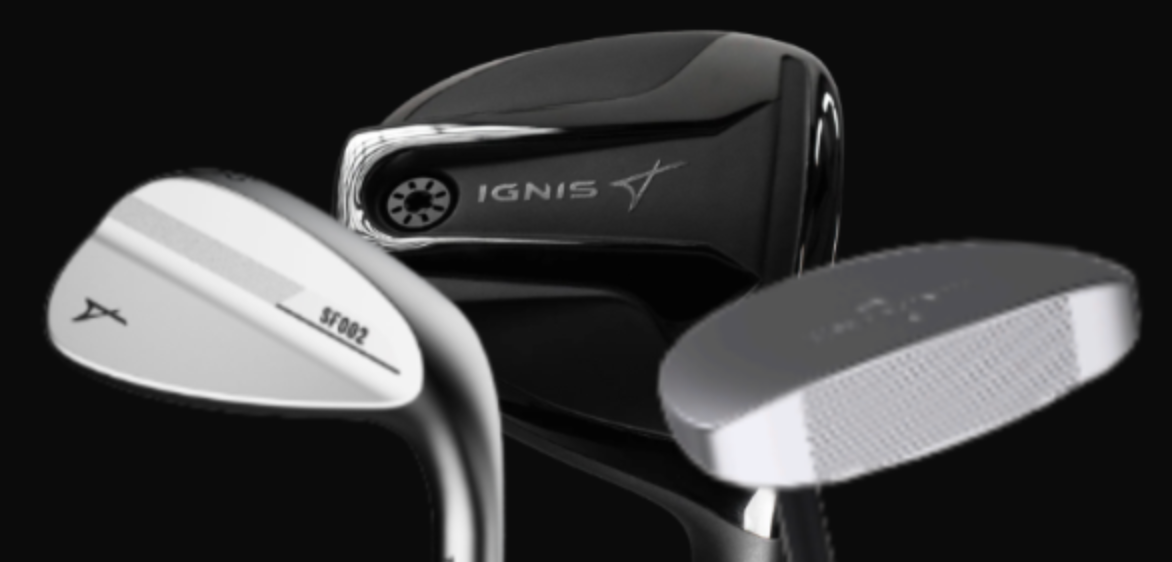




Most modern pitching wedges carry between 43° and 47° of loft, and the strongest game-improvement sets go down to about 41°. In game improvement and players distance irons the lofts are designed stronger to add distance, so their pitching wedge often carries the loft an old 9-iron used to. Players irons keep traditional lofts, and they are not going anywhere.
Because lofts differ this much from one type of set to another, the right pitching wedge degree for you isn't a number on a chart. It's whatever your iron set already chose, and across our current sets the pitching wedge runs from 43° to 47°, with every pitching wedge sitting exactly 5° above its 9-iron. This guide walks you through the typical loft for each type of set, how to find yours, which wedge to add after it, and when a separate pitching wedge earns its slot.
Typical Pitching Wedge Degree by Set Type

The type of iron decides the loft far more than the letter on the sole does. Forgiving distance sets run the strongest lofts, while players cavity backs and blades keep a more traditional pitching wedge.
| Set type | Typical PW | Our set and its PW |
|---|---|---|
| Forgiving distance | 41° to 44° | 101 MKII, 43° |
| Most current sets | 44° to 46° | 201 MKII, 46° |
| Players and blades | 46° to 47° | 201T MKII and 301, 47° |
The 301 row covers the CB, MB and Combo, which all share the same 47° pitching wedge.
The pattern follows the rest of the set. Take our Iron 101 MKII, a distance set that starts at 29° in the 7-iron and finishes on a 43° pitching wedge. Meanwhile, the 301 CB has a 34° 7-iron and lands on 47°. The 101 MKII and 301 CB sit 4° apart at the pitching wedge, so a single standard loft doesn't exist.
How to Find Your Own Pitching Wedge Loft
According to The Left Rough, a golf equipment review site, most pitching wedges "don't make it obvious what degree of loft the club is." Without that number, you can't plan the wedges below it. The loft lives in your set's spec table, not on the club.
Look up your iron model's specs and read the loft row under P. Then read the 9-iron next to it, because the step between the two tells you how the set was gapped. On our current sets the step is 5° every time (101 MKII 38° to 43°, 201 MKII 41° to 46°, 301 and 201T MKII 42° to 47°), so if you know one, you know the other.
Write that pitching wedge degree down before you shop for anything else. Every wedge you buy afterwards steps down from it.
Why the Pitching Wedge Keeps Getting Stronger
The pitching wedge used to carry a lot more loft. Terry Koehler, who writes the Wedge Guy column for the golf equipment site GolfWRX, noted in 2022 that the old true pitching wedges carried "about 50-52 degrees of loft". By 2022, he wrote, most game improvement and players distance iron sets had their pitching wedge at about 45 degrees, with some down to 42. Players irons never followed. Their pitching wedges still sit at 46° to 47°, by design, not by drift.
According to Golf Sidekick, a golf instruction site, a set from nearly 20 years ago could have a 44° 9-iron and a 48° pitching wedge, and lofts got stronger because golfers wanted longer shots. Modern heads launch the ball higher, so a stronger 9-iron can fly as high as the old one while going further. The golf equipment testing site MyGolfSpy puts today's spread plainly in its 2026 wedge setup guide: a pitching wedge "in one set might be 41 degrees while another is 46 degrees."
A stronger pitching wedge leaves a bigger loft and yardage gap down to your sand wedge, so the wedges you add below it have more ground to cover.
What Wedge to Add After Your Pitching Wedge

Once you know your pitching wedge degree, the next club is a gap wedge. The Left Rough puts the jump from a pitching wedge to a sand wedge at usually 10 to 12 degrees, which is far too big a hole to leave open. GolfTec, a golf lesson and club fitting company, is more specific: if your pitching wedge is 44° or stronger, your first dedicated wedge should be no more than 48° to 50°.
Here's how that builds down from the three pitching wedge lofts on our sets, rounded to lofts that actually exist:
| Your PW | Gap wedge | Sand wedge | Lob wedge |
|---|---|---|---|
| 43° | 48° | 52° | 56°, then 60° |
| 46° | 50° | 54° | 58° |
| 47° | 52° | 56° | 60° |
MyGolfSpy's goal is "even loft gaps, typically four degrees apart," and GolfTec's own wedge chart lands on the same 52°, 56° and 60° behind a 48° pitching wedge.
The 43° row is the one to get right. Leave out the 48° and a 43° pitching wedge sits 9° away from a 52°, a hole you'll meet every round. The Iron 101 MKII handles this for you, since the set runs 5 through GW with a 48° gap wedge in the box.
Whichever set you play, three added wedges usually take you to 60°. Rule 4.1b of the Rules of Golf sets the limit at 14 clubs, and every extra wedge is paid for with a slot from your long game.
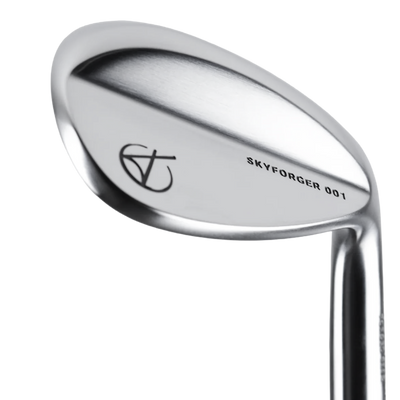
The Skyforger 002 comes in every loft in that table, from 46° to 60° in even steps. For left-handed golfers it's available at 48°, 52°, 56° and 60°, which covers the 43° and 47° rows exactly.
When a Separate Pitching Wedge Makes Sense

For most golfers, the set pitching wedge is the right one to keep. It matches the irons above it in loft step, look and lie, and our guide to how many clubs fit in a golf bag says it in one line: "A pitching wedge usually comes with your iron set."
A separate one makes sense when you want the scoring slot to play like a wedge instead of a short iron. A set pitching wedge shares the head design of the irons above it, with 2.32 mm of offset on the 201 MKII and 1.3 mm on the 301 CB. The Skyforger 002, by contrast, has 0.1 mm.
At 46° and 48°, the Skyforger 002 uses our F grind with 8° bounce. We built it as "a thicker sole and lower bounce grind for maximum forgiveness," meant for shots played with a square face. On GolfTec's bounce chart, 8° counts as low bounce, which helps the leading edge get to the bottom of the ball from tight lies and firm ground.
If you buy a separate Skyforger 002 pitching wedge, pick the loft 5° above your 9-iron. A 41° 9-iron takes the 46°, a 43° 9-iron takes the 48°.
Check the Yardage Gap, Not Just the Degrees
Degrees are the plan, but yardage is the test. Golf Sidekick puts the average male golfer's pitching wedge at about 100 yards and a PGA Tour pro's at 146, which shows how little a loft chart says about your own carry.
GolfTec links a 6° gap between wedges to a carry difference of about 10 to 15 yards. Our golf club distance chart calls the same 10 to 15 yards a healthy gap between clubs.
Hit your 9-iron, pitching wedge and first wedge on a launch monitor or a quiet range. If two of them land at nearly the same distance, you're carrying one club twice. If the jump is well past 15 yards, you need a loft in between. Take the distance you hit most often rather than your personal best.
Here's how to decide:
- Keep your set's pitching wedge if it sits 4° to 5° above your 9-iron, which is how most sets come.
- Add a 48° gap wedge first if your set ends at a 43° or 44° pitching wedge, before you think about anything above 52°.
- Add a Skyforger 002 46° or 48° if you want a wedge sole and almost no offset in that slot, matched to the 5° step from your 9-iron.
Which Pitching Wedge Degree Fits Your Bag
So what should you actually buy? The spec that decides it is the iron set, because the pitching wedge comes with it and every wedge below steps down from that loft. Run our fitting tool to find the irons that match your swing today, then check the loft listed for its pitching wedge and select your Skyforger 002 wedges down from there.
FAQs About Pitching Wedge Degree
What Degree Is a Standard Pitching Wedge?
There's no standard any more. Most current sets run from about 43° to 47°, with the strongest game-improvement sets near 41°. On our sets the range is 43° (Iron 101 MKII) to 47° (201T MKII and the 301 CB, MB and Combo).
Is a 52 Degree Wedge a Pitching Wedge?
No. A 52° is a gap wedge on almost every modern set, since pitching wedges sit well below 50°. When your set ends at 47° or 48°, a 52° is usually the first wedge you add.
Is a 48 Degree Wedge a Pitching Wedge or a Gap Wedge?
It depends on the set. On the Iron 101 MKII, 48° is the gap wedge, sitting 5° under a 43° pitching wedge. Behind a 47° pitching wedge, a 48° is only 1° away and adds almost nothing.
What Wedge Should Go After a 46 Degree Pitching Wedge?
A 50° keeps the four-degree step, followed by 54° and 58°. You end up with three wedges under the pitching wedge, each 4° apart.
Should My Pitching Wedge Match My Irons?
Usually, yes. The set pitching wedge keeps the same loft step, look and lie as the irons above it. A separate 46° or 48° wedge makes sense when you want less offset and a wedge sole in that slot.


