


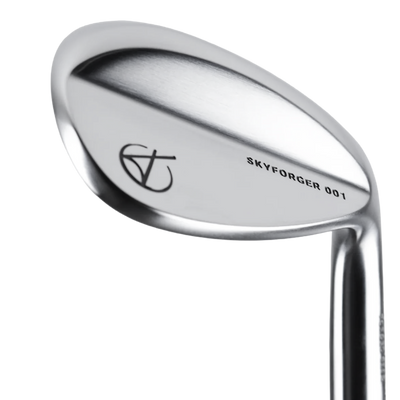


A blade iron hides nothing. Every gram of weight sits directly behind the sweet spot, which rewards a pure strike and exposes a bad one.
That honesty is what makes blade irons so rewarding for consistent ball-strikers and so unforgiving for everyone else. Takomo Golf builds its own muscleback around that tradeoff, so whether one belongs in your bag depends on your swing.
What Sets Blade Irons Apart
A true blade is forged from a single solid piece of steel. The mass sits directly behind the face, not spread around the perimeter for help. That construction is what actually defines a blade. You see it in the thin topline and the minimal offset.
Most modern irons fight mis-hits with internal weighting pushed to the perimeter. The USGA caps how forgiving that makes a driver head yet sets no ceiling for irons. Blades take none of that help. A solid strike is all they lean on.
The numbers behind that construction stay consistent across true blades:
- Loft: 34 degrees on a 7-iron, the traditional angle that has not drifted with the marketing.
- Offset: 1.8 mm, leaving nearly all face control in your hands.
- Blade length: 71 mm, compact enough that a mis-hit shows up immediately.
Who a Blade Is Actually Built For

A blade is built for the golfer who already finds the center of the face consistently. Ambition has nothing to do with it.
Ball-Striking Consistency Comes First
A blade only rewards a repeatable strike. Miss it by half an inch, and the ball loses speed and direction at once. No perimeter weighting is there to catch it. That is the real filter for whether a blade belongs in your bag, not your handicap number alone.
Workability Matters More at This Level
Shot shaping is the other half of the decision. A blade lets a skilled player move the ball both ways and flight it down under wind. The compact head responds instantly to small changes at impact. That responsiveness has no value if you are not shaping shots on purpose yet.
The Honest Signs You're Not Ready Yet
A handicap in the high teens or worse, with contact that still moves around the face, is the clearest signal to wait. The gap between that and the repeatable center strike a blade needs is a long stretch of golf. Players closing it usually land in players cavity backs and low-handicap irons instead. Those still reward a good strike without the full mis-hit penalty.
What You Gain When You Give Up Forgiveness

The payoff is direct feedback and total control. A pure strike tells you everything went right. A mis-hit tells you exactly where it broke down, feedback that most game improvement irons sand down on purpose.
That feedback loop is the part of blade design we obsess over at Takomo. A golfer who can already work the ball both ways deserves an iron that gets out of the way. The Iron 301 MB is built around that exact demand. It is forged from a single billet of steel, without the legacy markup.
Where the Blade Fits in Takomo's Iron Sets
The Iron 301 MB is Takomo's only true blade, a forged muscle back for players who already own their strike. The lineup steps down from there. The Iron 301 CB keeps the forged feel and adds a shallow cavity that widens the sweet spot without dulling the feedback. The 201T MKII goes a step further, a players precision iron for a clean striker who wants workability without a full blade.
Blades also carry a price myth. Grand View Research reports that more golfers are choosing custom-fitted clubs and buying direct. Takomo forges the same steel across the 301 line and skips the markup. The blade you grow into stays a fitting decision, not a budget one.
|
Iron |
Type |
Best For |
|---|---|---|
|
301 MB |
Forged muscle-back blade |
Elite strikers who shape shots |
|
301 CB |
Forged players cavity |
Consistent strikers, who want shot shaping with a touch of forgiveness |
|
201T MKII |
Players precision |
Clean strikers not ready for a full blade |
Play the Iron Your Swing Has Earned
A blade rewards the golfer who finds the center of the face and works the ball on purpose. The thin topline, the minimal offset, and the weight behind the face only pay off once that strike is repeatable. Match the iron to the swing you have today, not the one you are chasing.
The honest way to know where you stand is to measure it, not guess from a handicap number. Takomo's fitting tool reads your swing and points you to the set that actually fits your game. Answer it honestly, and you'll know if you're ready for a blade.
FAQs About Playing Blades
Is a Muscleback the Same as a Blade?
Yes. "Muscleback," "MB," and "blade" describe the same design: mass concentrated behind the face. Traditionally this means a solid forged bar with no cavity, but muscle back can also be built as a hollow body for added forgiveness.
What Is the Difference Between a Blade and a Players Iron?
Every blade is a player's iron, but not every player's iron is a blade. Players' irons include forged cavity backs with a little forgiveness, while a blade keeps all the mass behind the face with little to no forgiveness.
Do Blades Need a Stiffer Shaft?
Not automatically. Shaft flex should match your swing speed and tempo, not the head you play, though stronger ball-strikers often end up in both.
Do Tour Players Still Play Blades?
Some do, but plenty pick a touch of forgiveness even at that level. Elite players earn a blade with repeatable contact, not because the tour asks for it.


