



You've probably heard that the best slow swing speed golf clubs start with a new "high launch" head. Swap the driver, get the ball up, and the problem's solved. The fix probably isn't the head at all. It's the order you buy your clubs in.
The best slow swing speed golf clubs are lighter and higher lofted than what most golfers carry, which means a lighter shaft, more loft on the driver, and lofted fairway woods in place of the long irons. The buying guides we read, from Golf Club Brokers, a golf club retailer, and CaddieHQ, a golf advice site, agree on that much. What they skip is the order, because a new "high launch" head on a shaft that's too heavy, in a bag that still carries a 4-iron, fixes very little.
So we'll follow the order a fitter would, starting with shaft weight, then where your bag switches from irons to woods, then driver loft. The iron head comes last, and it matters less than the ads suggest.
What Counts as a Slow Swing Speed
There's no official line, and the sources don't agree on one. Golf Monthly, a UK golf magazine, calls a slow swinger anyone "with a clubhead speed under 85mph," while CaddieHQ puts it at "generally under 90 mph with a driver."
We fit a stiff shaft to a driver swing speed of 95 to 105 mph. Everything in this guide is for golfers slower than stiff. For context, Trackman, a launch monitor maker, published averages in 2024 that put the average male amateur, a 14.5 handicap, at 94 mph with the driver, and a 15-handicap female amateur at 79 mph. So the average golfer already sits below the stiff band, which makes a slow swing common, not unusual.
For your irons, though, the number that matters more is 7-iron speed. It's the figure Golf Club Brokers uses to sort its shafts, and it's the one our fitting tool asks for.
Our guide to golf clubhead speed covers how to get faster, while this piece is about the clubs that fit the speed you have today.
Slow Swing Speed Golf Clubs Start With Shaft Weight

Start with what the shaft weighs. "A typical steel shaft weighs 110–130 grams," notes Golf Club Brokers' 2026 iron guide. "A senior graphite shaft weighs 50–75 grams." That difference rides in every iron you swing.
The table below lists shaft options for our Iron 101 MKII, lightest at the top. It isn't our fitting tool, and the fitting tool gives you the exact shaft for your set.
Ball flight is how high the shaft launches the ball, spin is the backspin it adds, both as the maker rates them. Weights are the shaft before it is cut to length.
| Shaft | Flex | Weight before trimming | Ball flight, then spin |
|---|---|---|---|
| True Temper Denali Silver | L-flex | 53 g | High, mid-high |
| Mitsubishi MMT | A-flex (senior) | 62 g | Mid, mid |
| Mitsubishi MMT | R-flex | 73 g | Mid, mid |
| KBS Tour Lite | Regular | 105 g | High, high |
| KBS Tour | Regular | 120 g | Mid, mid |
The KBS Tour Lite is the one steel option in the table, and it sits at the heavy end. Raw, it weighs 105 g in regular and stiff, rated "High/High" (the first word is launch, the second is spin), and our standard KBS Tour steel shaft weighs 120 g in regular and 130 g in stiff. Every shaft weight here is raw (uncut), so expect the installed shaft to weigh less after it's trimmed to your club length.
If your fitting lands in Ladies, Senior or Regular flex, you're looking at the graphite custom options instead. True Temper Denali Silver runs from 53 g in L-flex (ladies) to 89 g in stiff, rated "High/Mid-High", and Mitsubishi MMT runs from 57 g to 86 g.
The gap between 120 g steel and the 53 g Denali Silver is a full 67 g raw, per shaft, and a lighter club is easier to swing faster at the same effort. That's not marketing. That's physics.
Switch From Irons to Woods Higher Up the Bag

A slower swing doesn't just send the ball shorter. It sends it lower. True Spec Golf, a club-fitting company, published launch targets through GOLF.com in 2020, with a peak drive height of 58–70 feet for slow driver swings, against 70–86 feet for average-speed swings. Less height leaves less room to stop the ball, and long approach shots feel it most.
Foresight Sports, a launch monitor maker, puts the target descent angle (the angle the ball lands at) in its 2025 iron study for holding a green with a 7-iron at 45–50°, a window that gets harder to reach as club speed drops.
The shot data backs this up in the real world. In 2020, Arccos, a shot-tracking system for golfers, went through more than 200 million recorded shots and found that every handicap bracket scored lower hitting a 4-hybrid off the tee than a 4-iron.
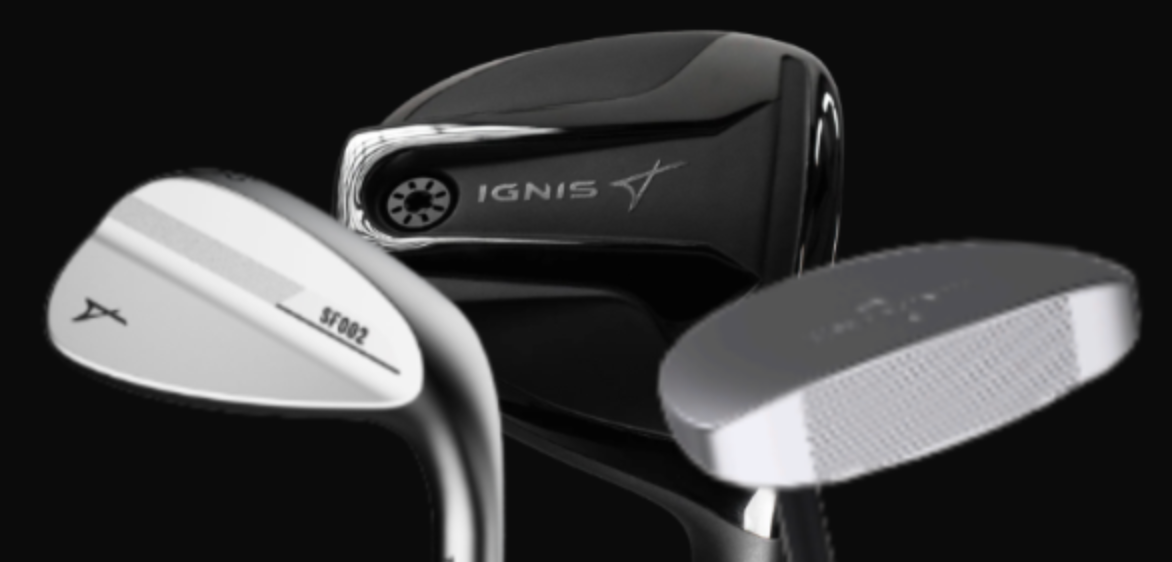
So test the switch point. For a slow swing, the 5-iron slot is where the choice sits, between our MKII 5-iron and the IGNIS D2 7-wood. On the IGNIS D2 fairway wood, "the carbon crown lowers the center of gravity to promote an easier launch," which is exactly the help a slower swing needs.
For that slot we'd pick our IGNIS D2 fairway wood, either the 18° 5-wood or the 21° 7-wood. It's built for "easy launch, forgiveness, and a higher-spinning flight built for accuracy and consistency." For a slow swing, pair it with the Fujikura Ventus Red shaft, rated high launch, mid spin, 58 g before trimming, in A-flex (senior).
Look at the lofts. Our MKII set's 5-iron has 23° of loft against the 7-wood's 21°, only two degrees apart.
Our Iron 101U driving iron set, a separate set from the MKII, covers the same part of the bag with a different flight. Its 2-, 3- and 4-iron have lofts of 18°, 20° and 22°, it's listed for a 0–15 handicap, and is built for "low spin, and bullet-like ball flights." Pick by launch: the IGNIS D2 7-wood when you want height and a soft landing, the 101U when you want a lower, piercing flight from the tee and the fairway.
More Driver Loft and a High-Launch Driver Shaft

The driver advice splits. CaddieHQ says to look for "at least 12 degrees of loft," while Golf Club Brokers' driver guide puts the best range for most slow swingers at 10.5–12°. The fitter's answer is that launch and spin decide, measured on a monitor, starting at 10.5°.
The IGNIS D2 driver comes in 9° and 10.5° with an adjustable adapter sleeve, and slow swingers should start at 10.5°. If a launch monitor still shows a low flight at that loft, that's a conversation for your fitting, not something to fix with swing changes.
The IGNIS D2 driver comes with two Fujikura Ventus shafts, the Red and the Blue. For slower speeds, pick the Ventus Red, the same model we pair with the fairway woods. In Regular flex both weigh 58.5 g uncut, but the Red is rated "High/Mid" for launch and spin against the Blue's "Mid/Low".
CaddieHQ's point is that a lighter shaft lets you "naturally generate more clubhead speed without changing your swing or exerting more effort." Trackman's figure is that 1 mph of club speed can add up to 3 yards with the driver. Length is the other lever. Our IGNIS D2 driver measures 45.75 inches, and if your strikes wander across the face, a shorter shaft is worth testing, because more centered strikes usually win back what the shorter length costs.
What to Look For in the Best Irons for Slow Swing Speed
Now the head. Golf Club Brokers says wide soles matter: "Wider soles do two things: lower the center of gravity (so the ball launches higher) and glide through turf better (so fat contact costs you less)." The general rule is that a low, deep center of gravity raises launch with no change to your swing.
Club fitters on a 2025 panel for GolfWRX, a golf equipment site, describe high-launch versions of game-improvement irons with lofts about 2 degrees weaker (more loft) than the standard set. Weaker lofts like that are aimed at height and a steeper, shot-stopping descent, which is what slower speeds need.
For this player, our answer is the Iron 101 MKII, a hollow-body iron. Its face and body are both cast stainless steel, and the face is thinner in some areas than others on the 5-iron through 8-iron. Its listed handicap range is 15–40+, it comes as a seven-club set from 5-iron to gap wedge, and MyGolfSpy, a golf equipment testing site, made it their Best Game-Improvement Iron of 2026.
The thing to know is the lofts. The 7-iron is 29°, the 6-iron 26° and the 5-iron 23°, the stronger lofts (less loft per club) game-improvement irons are designed with. Paired with a light, high-launch shaft like the True Temper Denali Silver, the 7- and 8-irons will fly fine for most slow swingers, while the 5-iron is the one to test against a 7-wood. For the full breakdown of hollow bodies, offset and sole width, our game-improvement irons guide goes through each in turn.
Put Your Slow Swing Speed Bag Together in This Order
The best slow swing speed golf clubs are the ones that get the ball airborne at the speed you have. In order, that's a shaft light enough for your 7-iron speed, fairway woods in the long-iron slots, a 10.5° driver on a high-launch shaft, and then a launch-friendly iron head.
A practical slow-swing bag looks like this: driver, 5-wood, 7-wood, the MKII irons from 5-iron to gap wedge, your wedges and a putter. Hit the 5-iron and the 7-wood side by side, and carry whichever goes farther and lands softer.
The first step is our fitting tool. It needs about three minutes and your actual 7-iron swing speed, and back come the head, the shaft stiffness and length, the lie angle and the grip size. Be honest with it, and the shaft question is settled. Begin with the Iron 101 MKII and the IGNIS D2 7-wood, with a two-year warranty behind both. Stock sets come with 30-day risk-free returns and customized sets are non-returnable, so settle the shaft before you order.
FAQs About Golf Clubs for Slow Swing Speeds
What Is Considered a Slow Swing Speed in Golf?
Golf Monthly draws the line at 85 mph with the driver and CaddieHQ at 90 mph. We fit stiff at 95 to 105 mph, so in practice a slow swing is anything slower than stiff. Trackman's average male amateur swings 94 mph, which makes a slow swing below average, not unusual.
Do Slow Swing Speeds Need Senior Flex Shafts?
Weight matters as much as the flex label. A swing slower than stiff calls for a softer flex, and Golf Club Brokers pairs senior or soft regular flex with 60–70 g graphite for the slower 7-iron speeds it sorts by. On the Iron 101 MKII that means the Mitsubishi MMT A-flex at 62 g raw, and the fitting tool settles the flex from your 7-iron speed.
Should a Slow Swinger Carry a 4-Iron or 5-Iron?
Not necessarily, the test decides. Arccos's data showed lower scores in every handicap bracket when golfers teed off with a 4-hybrid instead of a 4-iron. Test the 21° 7-wood against the 23° 5-iron, or the 22° 101U (the 4-iron) if you want a lower flight, and keep whichever carries farther and lands where you want it.
Do Slow Swing Speeds Need a Low-Compression Ball?
Not necessarily. Today's Golfer, a UK golf magazine, tested 62 balls with a swing robot at 78 mph in 2025, and every ball it ranked carried between 160.8 and 163.6 yards, and its verdict is that soft balls aren't "any better (or worse) than firm golf balls for golfers with slow swing speeds." Pick the ball that spins enough around the green, then sort out your clubs.


