



Five numbers on a wedge spec sheet are worth reading before you buy, and on a well-built stock wedge only three of them really change the shot. The trick isn't learning every number on the sheet. It's knowing which few matter.
Golf wedge specs split into two lists, specs that change how the ball comes off the face and specs that change how the club looks in the bag, and our honest starting point is knowing which list you're looking at. The five to read on any spec sheet are loft, bounce and grind, lie, length with swing weight, and grip size. On a well-built stock wedge, loft, bounce and grind are the choices that matter, and the rest is already set right for most golfers.
This guide takes the five in that order, so you can pick the loft, bounce and grind that fit how you play and leave the rest to us, because we've already done it.
Wedge Specs Split Into Two Lists

Every spec on a wedge spec sheet falls into one of two lists. Some change how the club meets the turf and the ball, while others change how the club looks in the bag. Both are fine to care about, as long as you know which list you're looking at.
| Spec | Changes how it plays | Your move |
|---|---|---|
| Loft | Yes | Choose first |
| Bounce, grind | Yes | Choose second |
| Lie angle | Yes | Already set |
| Length, weight | Yes | Already set |
| Grip size | Yes, feel | Pick a size |
| Stamping, paint | No | Already set |
The first four decide your distance gaps, how the sole meets the turf, where the ball starts and how the club swings, and grip size decides how the club sits in your hands. The last one only decides how the club looks in the bag.
Notice how few rows ask you to choose. Loft, bounce, grind and grip size are your picks, while lie, length, weight and finish arrive already set, at numbers that suit most golfers.
Loft and Bounce Come First
Start at your pitching wedge loft and work down in even steps, 4° or 6°, until you reach the highest loft you actually hit. The rules give you 14 clubs in total, so every wedge you add takes a slot from somewhere else. We'd pick the lofts that fill real distance gaps, not the ones that look complete.
Bounce comes with the loft. Higher bounce resists digging in soft turf and sand, whereas lower bounce sits closer to firm ground and tight lies. Match it to your course and the way you swing into the ground, steep or shallow.
That's why we built a wide loft and bounce range, so it does the fitting work for you. Lofts on the Skyforger 002 wedges run 46° to 60° in 2° steps, eight in all, at $99 USD each, and from any even-numbered pitching or gap wedge loft, that covers 4° or 6° gaps.
| Loft | F grind | V grind |
|---|---|---|
| 46°, 48°, 50° | 8° | None |
| 52°, 54°, 56° | 10° | 12° |
| 58°, 60° | None | 12° |
Two grinds per loft through the middle of the range let you choose a square-face sole or an open-face sole at 52°, 54° and 56°.
Grind Is the Spec You Feel Around the Green
Grind is how the sole is shaped behind the leading edge, and it decides how the wedge sits when you open the face and how it exits the turf. Loft sets the distance. Grind sets how the sole works through turf and sand when you open or close the face.
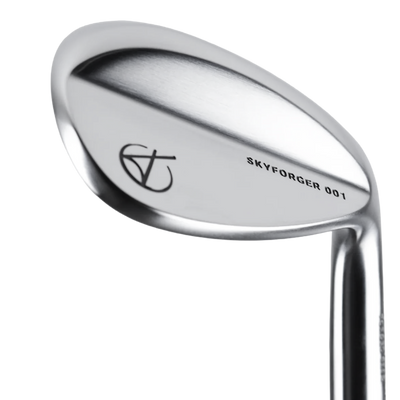
The Skyforger 002 is available in two grinds:
- F grind: a thicker sole and lower bounce grind.
- V grind: higher bounce with a tapered cut on the rear of the sole, so the face sits flatter when you open it.
If you mostly hit full and three-quarter shots with a square face, the F grind is the simpler choice. Whereas, if you like an open face on greenside shots, the V grind is built for it. And if your lies vary, the split we'd suggest is an F in the gap wedge and a V in the sand and lob wedges.
The full-face groove pattern is a design and look preference, and no handicap bracket is excluded from it or steered toward it.
Lie, Length and Swing Weight Come Already Set

These three never show up in a product photo, yet they still decide where the ball starts and how the club feels. On a good stock wedge they're set at numbers that suit most golfers, so your job is to read them, not to change them.
Lie angle. Typical wedge lie sits at 63 to 64 degrees, and the Skyforger 002 is 64° in every loft, right in that range. Our lie angle guide explains the direction effect. Toe up means too upright, and a right-handed player pulls it left, while heel up means too flat, and the ball leaks right. The loft, bounce and grind you choose move your wedge game far more than a degree of lie.
Length and swing weight. The Skyforger 002 is built to D2 swing weight, with head weights from 300 g at 46° to 316 g at 60°. Per our swing weight guide, adding an inch of length raises swing weight about 3 points, and two grams on the head adds about 1 point. That's why a set length and a set swing weight matter, since every loft then swings the same. Lead tape is the simplest way to add head weight, and it peels off again.
There's one rules note. Under Rule 4.1a(3) of the Rules of Golf, you can't make a stroke with a club whose playing characteristics you deliberately changed during the round, for example by physically changing it. Put lead tape on at the 9th tee and hit a shot with that club, and the penalty is disqualification, so make every change at home.
Finish Is Set, Grip Size Is Your Call
Stamping and paint fill are cosmetic, a good reason to love a club but no reason to expect a better shot. On the Skyforger 002 they come as designed, so there's nothing to add to the bill.
Grip is the exception that sits between the two lists. Grip size is a fit spec, so match it to the grips on your irons. The Skyforger 002 comes with a Lamkin Crossline grip in standard or midsize, in the black colour.
The KBS Tour stiff steel shaft fitted to every Skyforger 002 weighs 130 g raw and less after trimming to playing length.
How to Choose Your Wedge Specs, in Order

Work in this order, from the pitching wedge down:
- Find your pitching wedge loft on your iron spec sheet.
- Choose lofts below it in even steps, 4° or 6°.
- Choose bounce and grind per loft from your turf and how you open the face.
- Match grip size to your irons.
- Read lie, length and swing weight on the spec sheet. On the Skyforger 002 they're already set for most golfers.
Steps one to four are your choices, while step five is a quick read, not a job. We think honest wedge shopping is mostly about choosing well, not paying more.
Left-handed players can choose the Skyforger 002 at 48° F, 52° F, 56° V and 60° V.
Fit Your Irons First, Then Build the Wedges Around Them
Your iron specs are the reference for your wedges, so here's the order to follow. Run the Takomo fitting tool for your irons first. It covers iron sets for now and returns the head, shaft length and stiffness, lie angle and grip size, and your wedge lofts build down from that set's pitching wedge.
Then choose your lofts and grinds from the Skyforger 002 range at $99 USD each, and pick the grip size that matches your irons.
FAQs About Golf Wedge Specs
Which Wedge Specs Actually Change How It Plays?
The performance specs are loft, bounce and grind, lie angle, length and swing weight, and grip size. Those change how the club meets the turf and the ball, while stamping and paint fill change only how it looks. Choose loft, bounce and grind first, and read the rest on the spec sheet.
Which Wedge Specs Do You Actually Choose?
Loft, bounce and grind. On the Skyforger 002 you also pick grip size, standard or midsize. Lie, length, swing weight, shaft and finish come already set, at numbers that suit most golfers.
Do You Need a Custom Lie Angle on a Wedge?
For most golfers, no. Typical wedge lie sits at 63 to 64 degrees, and the Skyforger 002 is 64° in every loft. The loft, bounce and grind you choose matter far more to how your wedges play.
Can You Add Lead Tape to a Wedge During a Round?
No. Under Rule 4.1a(3) of the Rules of Golf, making a stroke with a club whose playing characteristics you deliberately changed during the round means disqualification. Make the change before you tee off.


